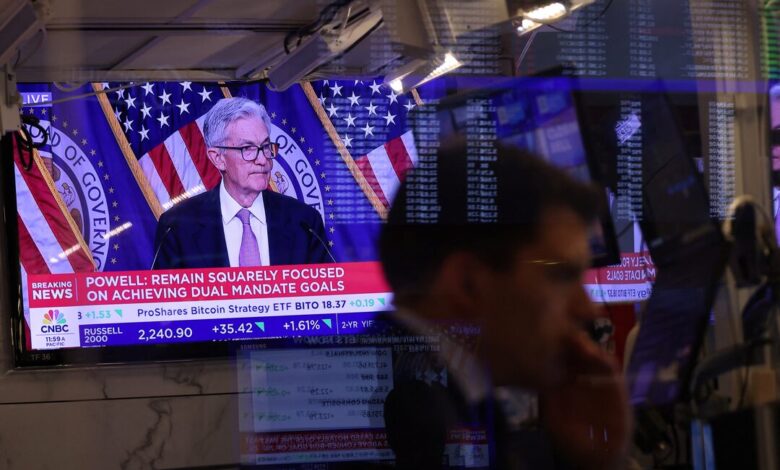
Global financial markets have experienced a significant rally in recent weeks as investors increasingly bet on impending interest rate cuts by major central banks. This bullish sentiment has propelled stock indices to record highs across multiple regions, with particular strength in technology and growth stocks that typically benefit from lower borrowing costs.
The current market dynamics reflect several important developments:
- Inflation cooling: Recent data shows inflation moderating in major economies, reducing pressure on central banks to maintain restrictive policies.
- Economic growth concerns: Signs of slowing economic growth have increased expectations for monetary policy support.
- Central bank signals: Policymakers at the Federal Reserve, European Central Bank, and other institutions have hinted at potential rate cuts in the coming months.
- Market positioning: Investors are repositioning portfolios in anticipation of a new monetary policy cycle.
Key Drivers Behind the Market Optimism
1. Inflation Trends Showing Sustained Improvement
The primary catalyst for the current market rally stems from consistently improving inflation data across major economies:
- U.S. core PCE inflation, the Fed’s preferred gauge, has fallen to its lowest level since early 2021.
- Eurozone inflation dropped more than expected in recent readings.
- UK inflation has returned to the Bank of England’s target range after peaking at double-digit levels.
2. Shifting Central Bank Rhetoric
Central bank communications have undergone a notable shift in recent months:
- The Federal Reserve has moved from “higher for longer” to acknowledging potential rate cuts in 2024.
- ECB President Christine Lagarde has signaled that discussion of rate cuts is underway.
- Bank of England policymakers have become more divided on the appropriate policy path.
3. Bond Market Reactions
The fixed income markets have been particularly sensitive to rate cut expectations:
- 10-year Treasury yields have fallen significantly from their October highs.
- Eurozone government bond yields have followed a similar downward trajectory.
- The yield curve has begun to steepen as short-term rate expectations adjust.
Sector Performance in the Rally
The anticipation of interest rate cuts has created distinct winners in the equity markets:
- Technology and Growth Stocks: These sectors, with their long-duration cash flows, have outperformed as discount rates fall.
- Small-Cap Stocks: More sensitive to financing costs, small caps have rallied on expectations of easier credit conditions.
- Financials: Banks have shown mixed performance, with concerns about net interest margins offset by relief about credit quality.
- Real Estate: REITs and property developers have rebounded as lower rates improve property valuations and financing conditions.
- Consumer Discretionary: Anticipation of stronger consumer spending in a lower-rate environment has boosted this sector.
Central Bank Policies and Expectations
Federal Reserve Outlook
The Fed’s projected path has evolved significantly:
- December 2023 dot plot suggested 75 basis points of cuts in 2024.
- Markets are pricing in more aggressive easing, with 125-150 basis points expected.
- Key considerations include labor market conditions and inflation persistence.
European Central Bank Position
The ECB faces different challenges than the Fed:
- Eurozone growth has been weaker than U.S. growth.
- Inflation peaked later in Europe but is now falling rapidly.
- Market expects ECB to begin cutting before the Fed, potentially in Q2 2024.
Historical Context of Rate Cut Rallies
Examining previous cycles provides valuable perspective:
- 2019: The Fed’s “mid-cycle adjustment” saw three rate cuts and a 28% S&P 500 gain.
- 2007-2008: Early rate cuts failed to prevent market decline amid financial crisis.
- 2001: Aggressive Fed easing provided only temporary market support during tech bust.
- 1995-1996: Successful “soft landing” scenario with rate cuts extending bull market.
Potential Risks to the Rally
Investors should remain aware of several risk factors:
- Inflation Reacceleration: Any signs of stubborn price pressures could delay or reduce expected cuts.
- Policy Mistakes: Central banks might cut too slowly (risking recession) or too quickly (reigniting inflation).
- Geopolitical Shocks: Conflicts or trade disruptions could impact commodity prices and supply chains.
- Earnings Disappointments: Market valuations assume earnings growth that may not materialize.
- Overcrowded Trades: Consensus positioning could lead to sharp reversals if expectations change.
Investor Strategies in a Rate Cut Environment
Sophisticated investors are implementing several strategies:
- Duration Extension: Adding longer-dated bonds to benefit from yield declines.
- Quality Focus: Emphasizing companies with strong balance sheets that can weather economic uncertainty.
- Sector Rotation: Moving into rate-sensitive sectors while reducing exposure to financials.
- Geographic Diversification: Allocating to markets where central banks have more room to ease.
- Alternative Assets: Considering real assets that may benefit from both rate cuts and persistent inflation.
Conclusion
The current market rally fueled by expectations of interest rate cuts reflects a complex interplay of economic data, central bank communications, and investor positioning. While the bullish sentiment appears justified by improving inflation trends and potential policy support, investors should remain vigilant about the risks that could disrupt this scenario. The coming months will be crucial in determining whether this rally marks the beginning of a sustained bull market or a more temporary reprieve in challenging economic conditions. As always, diversification and careful risk management remain essential in navigating these uncertain markets.
Frequently Asked Questions
How long do market rallies typically last when driven by rate cut expectations?
Historically, rate cut rallies can last several months to over a year, depending on whether the economic soft landing scenario materializes. The 1995-96 and 2019 episodes saw sustained gains, while 2000-01 and 2007-08 rallies proved short-lived as recessions took hold.
Which sectors tend to perform best after the first rate cut?
Analysis of previous cycles shows technology, consumer discretionary, and industrials typically outperform in the 6-12 months following initial rate cuts. Financials often underperform initially due to net interest margin compression.
Could markets decline even if rate cuts occur as expected?
Yes, if rate cuts are accompanied by significant economic deterioration or earnings declines. Markets care about why rates are being cut – preventive easing is viewed more positively than emergency cuts during crises.
How accurate are market predictions about the timing of rate cuts?
Market pricing has often been too aggressive in predicting rate cuts. While directionally correct, the exact timing and magnitude frequently differ from expectations. The Fed has emphasized data dependence in its decisions.
What should bond investors do in this environment?
Bond investors may consider extending duration to lock in higher yields before potential cuts, while maintaining credit quality. A barbell strategy combining short and long maturities can balance interest rate risk and yield.